 the Parliamentary Jazz Award in 2019 for his album Turas and he accompanies Glaswegian Luca Manning on the album When the Sun Comes Out. Luca recently won the Parliamentary Jazz Award this year’s Best Newcomer.
 [Some computers might ask you to allow the music to play on this page]
Completing Jazz Studies by Howard Lawes
|
This year, most students have had their courses disrupted by the Coronavirus pandemic. Howard Lawes has been looking at what it has meant for students on some of the Jazz courses in the UK:
For jazz students completing their courses at universities and conservatoires the last few months are when it all comes together, examinations are sat, recitals performed and the final results determined leading to degree class and the winning of prizes. Unlike a lot of academic study, performance art courses emphasise group activity such as dance, theatre and for musicians playing in orchestras and ensembles. One of the memories for students graduating in 2020 will be the lockdown which meant working from home and missing out on physically mixing with others, so that for music students, technical innovation was required to facilitate any group performance and doubtless the word ‘Zoom’ entered the musical glossary.
In Scotland the only full-time degree level course in Jazz is provided at the Royal Conservatoire of Scotland in Glasgow. The Jazz Department is headed by Professor Tommy Smith OBE who was kind enough to spend some time explaining how his department coped with the unprecedented circumstances posed by the pandemic. The Jazz course only started in 2009 following a sustained campaign by Tommy Smith over many years. One of his star graduates is Fergus McCreadie who wonthe Parliamentary Jazz Award in 2019 for his album Turas and he accompanies Glaswegian Luca Manning on the album When the Sun Comes Out. Luca recently won the Parliamentary Jazz Award this year’s Best Newcomer.
Tommy Smith
The BMus Jazz course in Glasgow takes six students per year and lasts four years, Tommy emphasised the practical aspects of the course which includes Music Business in each year as well as subjects such as theory, performance, arranging, studio recording and website design. Tommy sees the development of a range of skills as extremely important for a young, career musician and this year their innovation and self reliance stood them in good stead to deal with whatever problems the pandemic posed. Extensive use was made of Zoom and Microsoft Team and a web portal was established to organise recordings of accompanied solos, feedback from staff and interactive assessments, and although the technology does not allow real-time ensemble playing, students were able to record parts which were shared with each other to construct an ensemble performance.
Apart from his own highly successful Jazz career Tommy Smith founded and leads the Scottish National Jazz Orchestra and the Tommy Smith Youth Jazz Orchestra which together provide opportunities for big band performance for musicians of all ages and many Royal Conservatoire of Scotland alumni have participated - although of course this year concerts have been cancelled. Each year prizes are awarded to students (click on the picture below for details) and this year James Mackay won the Joe Temperley Prize for Jazz Arranging, Richard Glassby won the George Duncan Prize for Jazz Composition and Matt Carmichael won the Fog Arts Prize for Jazz Improvisation.

James Mackay is a talented guitarist and improviser who arranged Benny Golson's Along Came Betty to win his prize. While he draws upon a range of influences including rock, classical and traditional Scottish music, jazz is his main passion and his speciality. James MacKay said: “RCS has been especially helpful and supportive in recent months, and it’s thanks to this support that we as students have been able to continue working towards goals and prizes such as this.” Richard Glassby has played with several bands including the Aberdeen Jazz Orchestra, the Aberdeen University Jazz Orchestra, The Houlies (Ceilidh band), Serial Chillers (Latin band) and Hamlet, a fusion jazz band. His RCS award recognises his suite of original music – What the Bop, Vehement, Eclipse, Corruption and In and Out.Richard said: “These pieces were a product of a great first year at the RCS where I’ve had the chance to work with some amazing musicians who have really brought my music to life.” Marked as ‘one to watch’ by Jazzwise magazine last year, 20-year-old saxophonist and composer Matt Carmichael is one of Scotland’s most exciting young talents. He regularly performs under his own name at the likes of Ronnie Scott’s, Edinburgh Jazz Festival, Celtic Connections and has had airplay on BBC Radio Scotland, Jazz FM and BBC Radio 3. Matt’s own tunes combine his love for jazz and folk, described as ‘music that’s beautifully sculpted and gorgeously melodic with an underlying sense of rhythmical power.’ His quartet features the award-winning Fergus McCreadie (piano), Ali Watson (bass) and Tom Potter (drums). They will record and release their debut album in 2020 thanks to the Peter Whittingham Development Award.
While a full time jazz course at undergraduate level is a relatively recent fixture in Scotland it has yet to arrive in Northern Ireland. Jazz at postgraduate level is studied at Ulster University Magee Campus where students follow a MMus Creative Musicianship syllabus under the irrepressible Dr Linley Hamilton; it is also possible to study for a PhD in Music (Creative Practice and/or Contextual Studies). Trumpeter Linley Hamilton has been a mainstay of the Northern Irish jazz scene for well  over two decades as a jazz musician, jazz educator, jazz radio broadcaster, and not least, as an utterly tireless advocate of the music and kindly described the effect of the virus at his university.
Dr Linley Hamilton
The last few months have seen extensive restrictions put in place due to COVID-19, and as such the University has had to follow the strict government advice which resulted in the cancellation of exams and the postponement of summer graduation ceremonies in June and July. Teaching during the last few months has been on-line using Zoom and Microsoft Teams and a series of MS PowerPoint projects has been designed and produced with embedded audio which entails a considerable initial investment of time for preparation. There has been some face to face rehearsal opportunity using protective screens but restricted to one day per week followed by a deep clean of the premises. There has been no access to libraries and other university facilities so considerable use has been made of online publications.
Despite the lack of undergraduate Jazz courses, jazz is enjoyed by students and staff at Ulster University. A weekly series of lunchtime concerts entitled Music@One has featured the Ulster University Jazz Band (UUJB) that is made up of undergraduate and postgraduate students studying at Ulster University. Led by Dr Linley Hamilton and conducted by Lewis Hanlon, the ensemble rehearses weekly. ConFusion is Ulster University’s newest Jazz ensemble, run by final year Music student and clarinettist, Ceara McErlean. Ceara will also be managing ConFusion as part of her second semester work placement. The ensemble has an ambitious programme, and is diligently working towards performing music by key jazz musicians Tom Harrell, John Coltrane, Kenny Garrett and Linley Hamilton. ConFusion members include Linley Hamilton (trumpet), Ceara McErlean (clarinet), Lewis Hanlon (alto saxophone), David 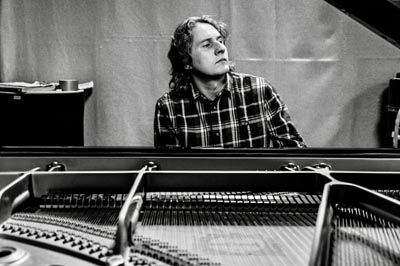 Chancellor (piano), Kevin Mullan (guitar), Serenah Zitouni, Luke Fleming (guitar), John Hodge (bass guitar) and John Goodman (drums). Sadly, performances by these bands have been cancelled.
Scott Flanigan
Conducting research at Ulster University at the moment is Scott Flanigan from Belfast, one of the foremost keyboard players on the Irish jazz scene and a member of the O'Higgins and Luft Quartet with Rod Youngs on drums who were nominated for a Parliamentary Jazz award this year. Like many musicians, Scott is offering tuition through FaceTime, Skype and Zoom. Over the years PhDs have been awarded to County Armagh born drummer and MOBO nominee David Lyttle and County Down born Steve Davis whose career includes playing with the European Jazz Orchestra and icons of the free improvisation movement.
To be honest it would seem that although students have been deprived of the opportunity to play together, and in some cases deprived of exams and graduation ceremonies, the completion of courses and award of degrees has proceeded as well as could be expected. It will certainly not have been the final months at university that students would have wanted so we offer our sympathy and wish them all the very best for their future careers.
Other pages you might find of interest :
© Sandy Brown Jazz 2020
Click HERE to join our mailing list