[Some computers might ask you to allow the music to play on this page]
Tony Coe Takes A Ride On Captain Coe's Famous Racearound by Robin Kidson
|
Any list of the most stylistically versatile jazz musicians must include Tony Coe in its top ten – top five, even. In a long career, he has done everything - from 'trad' to 'free', Humphrey Lyttelton to Derek Bailey. Throw in some jazz-rock, pop and classical and you have one of the great all-rounders.
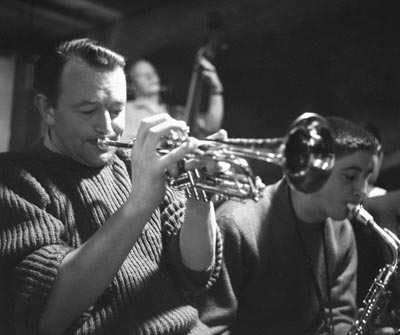
The trouble with all-rounders, of course, is that they become jacks of all trades and masters of none. This hasn’t been a problem with Tony Coe. On his chosen instruments – saxophones and clarinet – he is supremely accomplished across all genres. A brilliantly instinctive and imaginative improviser, he is also a gifted composer: the all-rounder’s all-rounder.
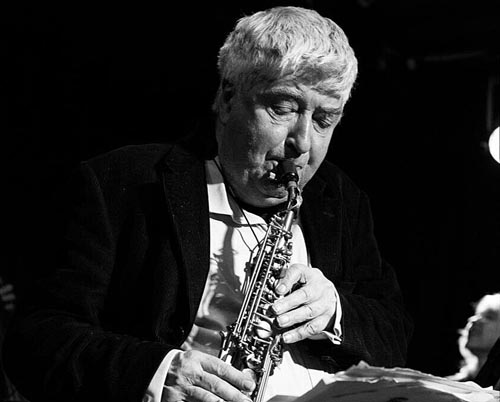
Tony Coe with Humphrey Lyttelton
Tony Coe’s talents received international recognition in 1995 when he was awarded the prestigious Danish JAZZPAR prize, sometimes called “the Jazz Nobel”. He was the first non-American musician to win the prize, part of which was the opportunity to perform live with a Danish ensemble. Accordingly, in March 1995, Coe played a series of concerts with both the Danish Radio Jazz Orchestra and a smaller “JAZZPAR Combo”. The concerts were recorded and a selection of the performances was issued on the Danish Storyville label with the title, Captain Coe’s Famous Racearound. Storyville has now reissued the record in a handsome package with new notes by Brian Priestley.
The reissue of Captain Coe’s Famous Racearound is an opportunity to look back on Tony Coe’s career. Born in Canterbury in 1934, he had formal clarinet lessons as a child and taught himself to play the saxophone. During National Service in the mid nineteen fifties, he played in an army band. He worked in Humphrey Lyttelton’s band from 1957 to 1962 and also started to lead his own groups. His reputation developed to such an extent that, in 1965, Count Basie, no less, offered him a job. Coe didn’t take up the offer but continued to be a much sought after sideman throughout the nineteen sixties.
Listen to Tony in 1963 on tenor and clarinet performing Work Song with Sandy Brown’s All Stars.
In 1967, Coe joined the international Kenny Clarke/Francy Boland Big Band. Here’s a clip of him playing with the Band, taking a solo on a suite called Faces which showcased a number of the Band’s members. The clip is from a film which not only featured the soloists playing but also showed them in their home lives:
As well as working in the mainstream jazz world, Coe has also been comfortable in freer, more avant garde environments. In the 1970s, for instance, he worked with Derek Bailey in the band Company; and has also collaborated with the likes of Tony Oxley, Lol Coxhill and Peter Brötzmann. And his interests extend beyond jazz. He has studied composition and played in classical music settings, most notably with classical clarinetist Alan Hacker in the ensemble, Matrix.
In 1976, Coe wrote, performed and recorded an extended work called Zeitgeist, a hybrid of classical, jazz and rock elements played by a large orchestra. The piece is dedicated to Alban Berg and Richard Rodney Bennett commented that “Berg’s music grew from a brilliantly fertile imagination controlled by a beautifully planned and articulated structure. Zeitgeist possesses precisely these admirable qualities”.
Coe’s compositional skills have been put to work on various film scores including for the Marie Epstein directed Peau de Pêche in 1995. He has also performed on other film scores including Superman II, Leaving Las Vegas and Victor/Victoria. The saxophone part in all the Pink Panther films (bar the first) was played by Coe including the Henry Mancini composed main theme.
From his 1985 album, Mainly Mancini, here is Coe playing the theme. He is joined by Tony Hyams on piano and Chris Laurence on bass:
The more popular end of the music spectrum has also employed Tony Coe’s talents to good effect and his characteristic sound can be heard on records by Paul McCartney, John Martyn, Georgie Fame and the Spencer Davis Group amongst many others. However, it is in jazz in all its forms where Coe really shines. His extensive discography reads like a Who’s Who of jazz. He has worked with some of the greats: Sarah Vaughan, Dizzy Gillespie, Stan Getz, Kenny Wheeler…. However, the considerable critical acclaim which has come Tony Coe’s way has been mainly directed at a series of albums on which he has been leader, composer or star performer: albums such as Coe-Existence (1978), Nutty on Willisau (1983), Canterbury Song (1988), and Ruby (1998).
Listen to the title track from Ruby:
Tony Coe is now in his late eighties and rarely performs. But, even into his seventies, he was still a force to be reckoned with. Here he is in 2007 with some characteristically adventurous improvisation playing T. Monk’s Blue Monk with John Horler on piano - click here.
When Captain Coe’s Famous Racearound was first released in 1995, it received wide critical acclaim – The Penguin Guide to Jazz on CD, for instance, calls it “a splendid record”. The reissued album has eight tracks recorded at various concerts in March 1995 in both Denmark and the UK. Coe plays clarinet, and tenor and soprano sax. Five of the tracks see him playing with the Danish Radio 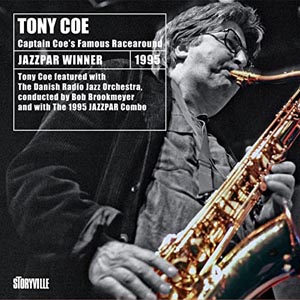 Jazz Orchestra made up mainly of top Danish players and conducted by Bob Brookmeyer. The orchestra is superb – as seen on the opening track which is an arrangement by Coe of the George and Ira Gershwin standard, How Long Has This Been Going On? The piece is bookended by a Prelude and Postlude both composed by Coe. Against the orchestra’s beautifully lush backing, Coe plays magnificently, fully justifying his reputation as one of the great balladeers of jazz. His improvisations take the tune for an extended and sometimes breathless run up hill and down dale, round the block, down the pub and back again. However, there is more than just technical competence at work here. Coe never forgets that he is working with a ballad and his playing invests the tune with the heartfelt intensity it deserves.
The next three tracks see Coe playing with the JAZZPAR Combo, a much smaller group than the full orchestra, and made up of Brookmeyer (valve trombone), David Hazeltine (piano), Thomas Oveson (bass), and Steve Argüelles (drums). On the first of these tracks, the Coe-penned Edmundo, the Combo is also joined by Henrik Bolberg Pedersen on trumpet. Edmundo is named after the band leader, Edmundo Ros, who Coe remembers for his “exhilarating and romantic Latin music and his warm personality coming over the air during my childhood, when there was much stress and hardship in Britain”. The tune is a memorable one, a reminder that Tony Coe is a skillful composer as well as everything else. The rhythm is jaunty and joyous and is guaranteed to set any foot tapping; the spirit of Edmundo Ros is most effectively channelled. As well as more dazzling playing by Coe, there are absorbing solos from Pedersen, Brookmeyer and Hazeltine.
You can hear Edmundo here:
The two other Combo tracks are compositions by Steve Argüelles. Toy Box sees Coe on clarinet freely improvising against a gentle percussive accompaniment by Argüelles. It sounds more like a piece of modern classical music – Messiaen, perhaps – than jazz, and illustrates Coe’s versatility as a musician seemingly able to turn his hand to almost anything. Antonia is most definitely jazz with a middle-eastern vibe and a hint of Jimmy Giuffre in folk-jazz mode. The melody is catchy, the beat is up. Coe plays soprano sax and rides the momentum of the piece finding a perfect groove. Brookmeyer takes a solo every bit as adventurous as Coe’s.
The it is back to the Danish Radio Jazz Orchestra with an interesting arrangement by Ole Kock Hansen of the standard, Fools Rush In. The track was recorded in the rather unlikely setting of the Playhouse Theatre, Whitley Bay. It is also back to ballad territory with the orchestra once again in fine form. Coe’s solo lasts almost the whole length of the piece and the dynamic between him and the orchestra is beautifully managed.
Listen to Fools Rush In.
The intriguingly titled Nasty Dance is a Bob Brookmeyer composition and at twelve minutes is the longest track on the album. It is a most original and imaginative piece of music constantly shifting gear from ominous military march to fanfare through free 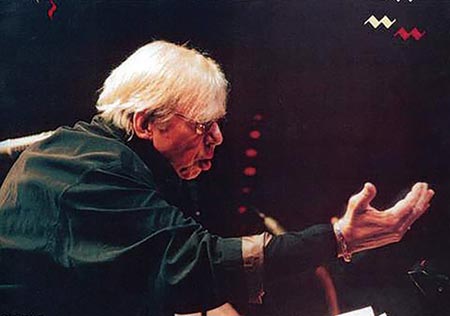 improvisation, discordance, lyrical ballad, and almost conventional big band blast. Coe, of course, handles it all with aplomb and expertly builds up to some thrilling and dramatic climaxes.
Bob Brookmeyer
The ballad, My Lament was written by Maria Schneider. The orchestral arrangement and playing is gorgeously succulent and Coe’s lyrical improvisations fit neatly into the spirit of the piece.
The best is left to last. The title track, Captain Coe’s Famous Racearound, was written by Tony Coe especially for the JAZZPAR concerts “in an atmosphere of white heat”. It is named after a toy-like device invented by the composer’s father, and is a glorious explosion of sound. It has a complex score which the orchestra manages with consummate ease, expertly marshalled by Bob Brookmeyer. If it was composed in an atmosphere of white heat, it is also played at that temperature. Coe’s playing whirls and fizzes, buzzes and twirls, venturing all over the place whilst still managing to keep in the saddle and control the momentum quite magnificently. His improvisations run the whole gamut of jazz styles: trad, free, bop, big band swing - all go into the heady mix along with elements of modern classical music. The music grabs the attention right from the off and never lets go, a most thrilling adventure. Coe is at the centre of things throughout – the stamina involved is almost as impressive as the writing and playing.
Listen to the track yourself:
Captain Coe’s Famous Racearound must go down as one of the highlights of Tony Coe’s glittering career. Having listened to it, one is left wondering why his name is not more widely known and celebrated beyond the jazz world. I have listened to a lot of great music in 2021 but none has given me greater pleasure than Captain Coe’s Famous Racearound, undoubtedly my Record of the Year.
For more information about Captain Coe’s Famous Racearound, including how to get hold of the album and samples of the tracks click here. Tony Coe’s website is here.
Other pages you might find of interest :
© Sandy Brown Jazz 2021
Click HERE to join our mailing list