
[Some computers might ask you to allow the music to play on this page]
Wes Reimagined by Robin Kidson
|
Guitarist, Nigel Price, that most prolific and hard-working of British jazz musicians, has released a new album on the Ubuntu label. It’s called Wes Reimagined and is a collection of tunes either composed by, or associated with, Wes Montgomery. Nigel has taken these tunes and given them a new twist.
“I make no secret that I’m a big Wes Montgomery fan”, he says, “Who isn’t?” It’s a sentiment shared by many other jazz guitarists: George Benson, Pat Metheny, Bill Frisell, John Parricelli…. all have acknowledged Wes Montgomery as a major influence on their playing.
Born in Indianapolis in 1923, Wes Montgomery taught himself to play the guitar, influenced at first by Charlie Christian. He played with the Lionel Hampton Band from 1948 to 1950 but rarely as a soloist. After leaving Hampton, he returned to Indianapolis and to his old trade as a welder. He still played in local clubs, however, and in bands with his brothers, Buddy and Monk. His guitar work began to be more widely noticed but his career didn’t really take off until he signed with Orrin Keepnews’ record label, Riverside. It was with Riverside that, 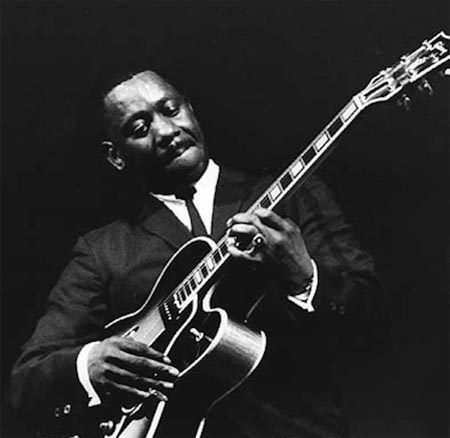 in 1960, he recorded his masterwork, The Incredible Jazz Guitar of Wes Montgomery, an album that regularly features in those lists of records any self-respecting jazz fan must have in their collection.
Montgomery went on to become a big jazz star, touring widely with a range of different musicians, including his brothers. He recorded more albums with Riverside until the label’s demise in 1964. He then signed with Verve and began making more commercial records with big band and string orchestral backings. These albums were both popular and financially successful - anathema, of course, to the jazz purist and many critics. Wes didn’t completely abandon straight jazz, however – his 1965 Verve album, Smokin’ At The Half Note, for instance, is regarded by Pat Metheny no less as the greatest jazz guitar record ever.
Wes Montgomery
Wes Montgomery’s career took an even more commercial turn in 1967 when he signed with Herb Alpert’s A&M label. His A&M output is basically pop music and the jazz critics of the time dismissed it accordingly, yearning for the old Wes to return. A later generation has been a little more forgiving, however, and Montgomery’s Verve and A&M work is now seen as a precursor of the whole acid jazz scene.
Wes Montgomery did not live to enjoy the full fruits of his financial success. He died suddenly of a heart attack in June 1968. He was only 45.
Wes was self-taught and, in the process, he developed his own idiosyncratic technique. He played with his thumb, plucking single note lines and strumming octaves and chords. The result is an attractive mellow sound. You can see the technique at work in this clip of him playing John Coltrane’s Impressions live in 1965. He’s joined by Harold Mabern on piano, Arthur Harper on bass and Jimmy Lovelace on drums:
Another notable feature of Wes Montgomery is that he couldn’t read music. This did not stop him becoming an accomplished composer as well as a formidable player. Tommy Flanagan, one of Montgomery’s collaborators, remembered “the first time I met Wes… Somebody must have written his own tunes out…because he had the music (with him). They were good songs… He was very shy and a little nervous because he couldn’t read…but his knowledge went far beyond anything we knew. We were stunned by his incredible musicianship”.
The nervousness observed by Flanagan was also noticed by others and manifested itself in various ways: an obsessive fear of flying, excessive cigarette smoking, a tendency to black out when under stress… But, interestingly, nerves rarely showed in his playing which comes across as relaxed and seemingly effortless.
And so to Wes Reimagined, which, to quote Nigel Price, “is a collection of the great man’s tunes, played in the same spirit but with a little look at what might have been… I got to thinking there was every chance that many of these tunes could have easily come out sounding very different if Wes had just been in an alternative frame of mind on the day. Hey, I haven’t tried to reinvent the wheel in any way – it’s just a kind of “what if”?... I also think that Wes’s honest, direct and melodic style directly influenced a lot of 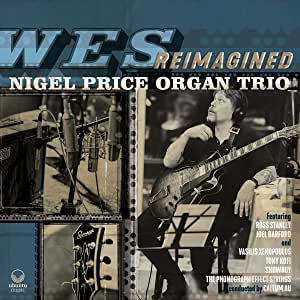 the funk, soul, boogaloo and earthy groove music that was to come shortly after his passing. I have no doubt that he would have been at the forefront of that movement. I’ve therefore intertwined some of these later styles with Wes’ music”.
Nigel is joined on the album by the other members of his long standing organ trio (Ross Stanley on Hammond organ and Joel Barford on drums) plus three guests: Vasilis Xenopoulos (tenor sax), Tony Kofi (alto sax) and Snowboy (percussion).
Interestingly, Nigel Price is not at all sniffy about Montgomery’s later, more commercial offerings with Verve and A&M. He wanted to acknowledge this work, he says, so he commissioned trombonist/arranger Callum Au to write string quartet arrangements for three of the tracks. These arrangements are played by the Phonograph Effect Strings (Kay Stephen, Anna Brigham, Elitsa Bogdanova and Chris Terepin) and are one of the many highlights of Wes Reimagined. Callum Au has managed to provide a vivid additional texture without being in any way obtrusive or lushly sentimental. On Cariba!, for example, the strings seem to emerge organically from some very earthy jazz providing a smooth background shimmer and a most effective contrast to the rest. In line with the “what if” approach, Price has turned Cariba! from Wes’s “groovy bossa” to “a kind of J.B’s ‘Doin’ it to death’ feel with perhaps a bit of the Hendrix track Rainy Day, Dream Away in there too”. The piece also has fine solos from Xenopoulos and Kofi and a friendly duel between the two in which they urge each other to ever freer and joyous playing. The strings are at work here too with some subtle interjections: “quirky pads and jabs”, Nigel calls them.
A video of the ensemble playing Cariba!
Callum Au’s string arrangements also enrich So Do It! Originally the theme tune to an American radio show in the 1960’s, Nigel Price has reimagined it as “a down tempo bolero”. The vibe is lazy and relaxed driven on by Snowboy’s percussion with the strings blending in beautifully. There’s also more nice work on alto from Tony Kofi.
Watch the ensemble playing So Do It!
The third tune on which the string quartet plays is the album’s final track, a version of the Lerner and Lowe standard, I’ve Grown Accustomed To Her Face. This is one of only two tracks on the album not written by Wes Montgomery. “Wes recorded the ballad…on the live album Full House”, says Nigel, “and I wondered what this would sound like with a more epic treatment. I wasn’t prepared for the depth and beauty of Callum’s incredible writing, not to mention the wonderful playing from the Phonograph Effect strings”.
Another outstanding feature of Wes Reimagined is the way in which guitar and organ work so well together. Of course, that almost natural symbiosis was something Wes Montgomery recognised as witnessed by his work with organist Melvin Rhyne and daddy of them all, Jimmy Smith. Nigel Price’s organist, Ross Stanley, is on fine form on Wes Reimagined, particularly on Movin’ Along where he utilises the full sound palette of his instrument to great effect. Price and Stanley hit a marvellous foot tapping, head nodding groove together.
Here's a live performance of Movin’ Along recorded at Peggy’s Skylight in Nottingham last October:
By way of contrast, here's how Wes Montgomery played Movin’ Along back in 1961.
The understanding between Nigel Price and Ross Stanley is also in evidence on the tracks For Wes and Road Song. Guitar and organ work hand in hand as if one mind is in charge of both instruments. The mellow electric sounds of both instruments complement each other so well. The effect is particularly striking in the interchanges between them on Road Song.
Throughout Wes Reimagined, the ensemble playing is exemplary. A fast, intricate tune like Leila, for example, is carried off by all musicians with aplomb. Nigel has turned Wes’s original “cool ‘west coast’ vibe to an out and out burner”. There are dazzling solos from guitar, sax, and organ with Joel Barford keeping the whole thing together on drums.
Listen to Leila.
There is more superb ensemble playing on Jingles, another fast intricate tune on which the percussion playing (congos, bongos, surdo, shekere and whistle) of Snowboy is particularly memorable.

Ross Stanley and Joel Barford
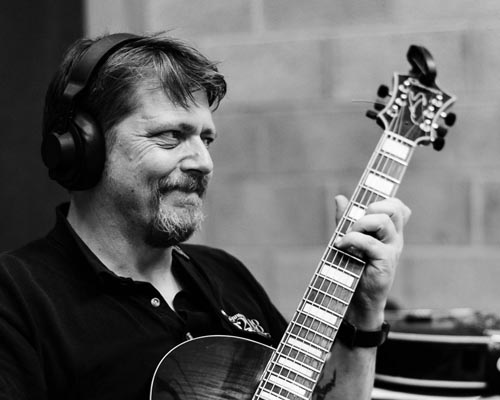
In the end, of course, Wes Reimagined is Nigel Price’s show and his guitar work on the album is mesmerising, as one might expect from a musician who has won so many plaudits in his career including Best Guitarist at the 2014 British Jazz Awards. His technique might be different from the Great Wes but the way in which he creates such dazzling sounds with apparently so little effort is the same. That technique is seen in all its glory in the videos selected in this article. His mastery of the instrument gives him both the confidence and the skill to pull off the most inventive and imaginative improvisations. On I’ve Grown Accustomed To Her Face, for example, Price invests the familiar tune with new embellishments making it live again almost as new. He does so without ever losing track of the main themes of the song.
Wes Reimagined, then, sees Nigel Price play a number of roles: as an instigator of intriguing and imaginative concepts, as someone with the organising and commissioning ability to bring those concepts to fruition, as arranger, leader and, above all, as a performing musician at the top of his game. The album will surely cement his reputation as one of the best jazz guitarists working in the UK today
Wes Reimagined also serves to remind us of Wes Montgomery not only as a superlative player but as a composer of memorable tunes. By looking at these tunes afresh and giving them a new, sometimes very modern twist, Nigel Price has done the memory of Wes Montgomery a great service. In that sense, Wes Reimagined is Wes rehabilitated for a new generation.
The Nigel Price Organ Trio is touring over the next few months: Dates include:
11th September: Isle of Wight Jazz Weekend
18th September: The Jazz Experience, Marlow
24th September: The Jazz Sanctuary, Twickenham
1st October: The Lighthouse, Poole
9th October: The Hive, Shrewsbury
13th October: Stratford Jazz
14th October: Wells Maltings, Norfolk
21st October: Seven Jazz, Leeds
7th December: Norwich Jazz
9th December: Fleece Jazz, Suffolk
For further details and samples of the album click here. For Nigel Price’s website click here.
Other pages you might find of interest :
© Sandy Brown Jazz 2021
Click HERE to join our mailing list