 d. He says:
Obviously writing about jazz and its development in New Zealand is a relatively large subject and this can only be an introduction and also an entirely personal view.
New Zealand has a population roughly one fifth that of Australia and so the development of jazz here is often that of a much smaller country with a larger one nearby - although four hours flying time is stretching ‘nearby’. Many of our better jazzmen have either temporarily or permanently crossed the Tasman to Australia where the larger population makes being a full-time musician possible, if still not at all easy. In New Zealand jazz has always been a minority interest and often the popular periods such as the English ‘Trad’ boom of the 1950’s, have almost completely passed us by.
Growing up in New Zealand in the 1950’s meant that we got most of our recordings from England rather than Australia or America. In the 1950’s it was a matter of hoping that the record store had got something in that you liked, only later could we send English postal notes to record stores in England and actually get what we wanted. It’s easy to understand the lack of American records - the dollar was high and we traded more with England anyway, but the lack of Australian jazz available at that time I still find strange. Most of the cars and general merchandise available when I was growing up in the 1940’s and 1950’s were English rather than American. For a long period of time it was illegal to have American dollars in one’s possession in New Zealand and while it was difficult to get hold of British pounds you could do so in a gradual way by purchasing 5/- English Postal notes. These were available one per person per day. In reality that meant lots of riding between post offices over several days buying one at each or else you got other people to also buy them.
During the late 1960’s and early 1970’s I lived in the country and visits to town or even to the small local post office some miles away always involved the purchase of a 5/- postal note. Many second hand records can still be found as well as many records in my collection from that era bearing the stamp of Peter Russell’s Hot Record store in Plymouth.
The first real jazz enthusiasts in the country were groups of pre-war fans who set up ‘swing clubs’ in the four main cities – Auckland, Wellington, Christchurch and Dunedin. They shared records around, and wrote and published their own magazines. I know some of these pre-war swing fans and their experiences are fascinating - usually punctuated by wartime service. There were also a few radio programmes that began to cater for the swing fans and those interested in hot music. One of these, ‘Rhythm on Record,’ hosted from Wellington by Arthur Pearce under the pseudonym ‘Turntable’, became one of the longest running radio programmes in the world and certainly the longest running jazz programme, running for exactly forty years from July 2nd, 1937 until the final programme on July 4th, 1977. Arthur used as his theme the fairly unusual Bob Crosby track ‘Woman On My Weary Mind’ which can still make older New Zealand jazz fans misty-eyed. Each programme began with Arthur asking ‘any rags, any jazz, any boppers today?’
The first recording made in New Zealand seems to have been by Epi Shalfoon’s Melody Boys recorded in Rotorua in October 1930. Only about a minute long it was the soundtrack for a travel film. Arthur Pearce also appeared as a pianist in records made in the late 1930’s most of these now surviving only as acetates.
Local record labels Zodiac and Tanza made their appearance as post-war labels. Early 78’s were often imported from Australia which generally produced poor quality thick discs with usually HMV 78’s having a EA prefix to the label number whereas British labels had the B prefix.
Growing up in the southern city of Christchurch and usually unable to get 'Turntable' on the radio, I grew up with the sounds of Ellington’s ‘Across the Track Blues’ and the distinctive tones of John S. Wilson introducing the Voice of America jazz programme late at night.
The major jazz event of the war years would have to be the visit to Australia and New Zealand of the Artie Shaw Navy band.
Both Australia and New Zealand were in great danger of invasion by the Japanese in 1942 and large numbers of American servicemen were stationed in New Zealand training for the invasion of places like Guadalcanal and Iwa Jima. Shaw arrived unannounced in July of 1943 but the local swing fans soon spread the word around and the lucky ones were able to get into the concerts that were primarily for the GIs. The unlucky perched near concert or dance hall’s open windows to listen. It wasn’t only Artie that interested the fans but also sidemen like Max Kaminsky and Dave Tough who were in the band. Eric Allen of Auckland recalls Tough being escorted to his drum kit on stage by two MPs. Also in the band were Frank Beach, Conrad Gozzo, John Best (trumpets), Earl ‘Dick’ Le Fave, Tasso Harris, Tak Takvorian (trombones), Mack Pierce, Ralph La Polla (altos), Sam Donahue, Joe Aglora (tenors), Charles Wade (baritone sax), Roscoe Coluccio (piano), Harold Wax (accordion), Al Horesh (guitar), Barney Spieler (bass) and arrangers David Rose and Dick Jones.
Max Kaminsky in his autobiography describes Auckland as ‘a sleepy little town, barely a dozen houses’, whereas in fact Auckland was a city of 250,000 at that time and whilst hardly a cosmopolitan city was certainly larger than Max recalled.
In 1947 another visitor was Rex Stewart who made four sides in Auckland backing singer Mavis Rivers. The local story has it that Rex finished the session and demanded he be paid by the other musicians for playing!
The 1950’s meant few visitors except those that came with other acts. I recall in 1959 seeing Stan Freeberg who had came with the Australian Jazz Quartet including Jack Brockenshaw (vibes) and Diana Trask as a support group. This group also produced some memorable jam sessions in local coffee bars. New Zealand had very restrictive liquor licensing laws until around 1967, which meant that all pubs closed at 6 p.m. with no Sunday opening at all and this severely limited the possible music venues. The concept of a pub as it is in England simply could not exist.
Probably the first jazz group imported on its own would have to be the duo of Pete Jolly and Ralph Pena who were bought to New Zealand from the West Coast of the USA by jazz enthusiasts John Good and Frank Collins in 1960. The tour was an artistic if not a financial success and they made some recordings while they were here. Both men were pleasant and entertaining performers and thoroughly nice guys. Pete Jolly went on to an interesting career and died in November 2004. Ralph Pena also recorded with West Coast groups including the Jimmy Guiffre Trio as well as Bob Brookmeyer and was killed in a road accident in Mexico City in 1969. Gradually the tours began of other jazzmen, usually as a sequel or prelude to their tour of Australia. Musicians would stop off on their way to or from Australia and play a Sunday evening session with local musicians.
The 1960’s began with the Dave Brubeck Quartet in April followed in May by the Modern Jazz Quartet, and in November/December Kenny Ball made the first of many visits to capitalize on his success.
In March 1963 Louis Armstrong made his first visit and in May/June of the same year Acker Bilk made his first visit. Unfortunately I was teaching in a very remote area for much of this time and missed these concerts. Kenny Ball came again in late 1964 as did Acker Bilk again and in 1965 we welcomed Eddie Condon and his all Stars with Buck Clayton, Bud Freeman and Jimmy Rushing as well as Thelonius Monk. The same year the Dutch Swing College came as did the University of Denver Big Band, then Armstrong again in 1966.
Both Kenny Ball and Acker recorded - Acker with Al Fairweather, John Mortimer, Bruce Turner, Stan Greig, Tony Pitt, Tucker Finlayson and Ron McKay. The ten titles they recorded in Auckland and Wellington have been released on the Columbia label on LP- I am not aware of a reissue on CD. Acker played Auckland, Wellington, Christchurch and Dunedin. They were back again for seven weeks in March and April, playing in New Zealand for ten days at the beginning of April before Al left the band. Acker came again in 1968.
In March 1970 I drove through the late afternoon some 100 kilometres on secondary roads to see and hear the Duke Ellington band in the Wellington Town Hall and then the 100 km drive home afterwards across some very hilly roads. This was to be the first and last chance to hear the Ellington band in New Zealand and indeed the last chance to hear Johnny Hodges who died a few months later. I remember remarking to the person next to me that I had waited 25 years to hear the Duke and he replied that it was more than 40 years for him! The following year the Basie band came and thrilled us with their power and precision.
As the biggest city, Auckland has always suffered from unsuitable venues and some suburbs were also ‘dry’ with bans on the sale of liquor, but through the 1980’s the Mandalay ballroom in Newmarket, in the central city, hosted such people as Lee Konitz, Art Hodes and many other American jazz musicians who got to play with a local rhythm section. These were Sunday early evening sessions and became enormously popular.
The bands of various kinds that have flourished have generally been part-time, weekend affairs. Some of the more notable have been the big bands of Bob Bradford and later of Rodger Fox whose Big Band played at Montreux in 1980. Smaller traditional jazz groups have been lead by people like trumpeter Lindsay Meech, pianist Ernie Rouse, trombonist Merv Thomas, reedman Ken Avery, clarinetist Tony Ashby, banjoist Paul Kimble and trombonist Bob Douglas to mention just a few. Mainstream musicians have included pianist Crombie Murdoch, and drummer Frank Gibson.
Undoubtedly the two New Zealand jazzmen who have made it to the international stage are both pianists. Mike Nock (born September 1940) and Alan Broadbent (born April 1947). Broadbent studied at Berklee before joining Woody Herman in 1969 as both pianist and arranger. He has continued to arrange for various vocalists and small groups.
Mike Nock also studied at Berklee and settled in Boston and recorded with Pharoah Sanders although in later years he has been working in Australia in modern groups and in the music industry.
The Tauranga Jazz Festival which began in 1964 has run every Easter since and has been joined by the Waiheke Jazz and Blues festival which combines the island venue with the local wines to attract what is for New Zealand a good crowd.
My first jazz record bought for 22/6d in late 1954 was Ken Colyer’s 'New Orleans to London'. Records were few and hard to find. Many of the records acquired in the 1960’s and 1970’s were imported from Peter Russell and other UK dealers. Currently we are in the happy position of having some of the cheapest compact discs anywhere in the world. In the mid 1990’s a New Zealand discount chain named simply ‘The Warehouse’ in the mould of Walmart started up and rapidly spread throughout the country with their large ‘red sheds’. Their policy of buying compact discs from central Europe by the container load and selling them cheaply at a low margin and high turnover has been a boon for all local jazz fans.
‘The Warehouse’ has become easily the biggest music retailer in the country and has meant that a huge range of jazz CDs have been on sale. The average price of compact discs is around $10 or less (currently the exchange rate is $1 NZ = 40p UK) and so we can buy compact discs for around four pounds. A specialist retail and secondhand store ‘Real Groovy’ started in Auckland in the mid 1970’s and now has stores in four main cities and sells music, books and DVDs and imports American deletions. Some Australian retail DVD and CD chains such as JB Hi Fi have moved into the New Zealand market recently and the American chain Borders have expanded their operation, although their future appears uncertain at the moment.
As in most countries jazz fans are aging and the newer fans probably have a more eclectic mix of jazz tastes. We older fans tend to use an informal internet group to keep in touch and to keep our interest alive.
It’s certainly a far cry from the days of cycling to buy five shilling English postal notes and waiting weeks for the records to arrive.
New Zealand jazz is a small but interesting corner of the world wide jazz scene with its own history and traditions.
© Roger Strong 2008
References:
Sinclair Robieson has written to Roger Strong about Roger's article 'Kiwi Jazz', and the development of jazz in New Zealand. It is interesting the influence that Willis Conover of Voice of America seems to have had both in New Zealand and in Poland. Can anyone else remember his broadcasts?
November 28th, 2008
Sinclair Robieson writes again: I have an apology to offer. John S. Wilson DID do a show on VoA, this comes from Bruce Talbot, to whom I mentioned the matter during a transatlantic exchange today. He should know - he worked for the NZBC at the time. Bruce thinks Wilson's programme was called 'The World Of Jazz'. Willis Conover's was called 'Music USA'. Bruce thinks that Wilson's might have been inserted into the VoA schedule at a time when Conover was away.
November 2008:
Sinclair Robieson has written about Roger Strong's article 'Kiwi Jazz', and the development of jazz in New Zealand. It is interesting the influence that Willis Conover of Voice of America seems to have had both in New Zealand and in Poland. Can anyone remember his broadcasts?
'In your piece on Kiwi Jazz (which
rings a load of bells cos I was born in Wellington in 1938), you
refer to listening to John S. Wilson on the Voice of America. With
all respect, I think you are confusing him with Willis Conover, the
VoA's regular jazz host. And yes, I used to listen to him on
shortwave late at night, too. Wilson was jazz critic for the New
York Times. I never heard him on the VoA'.
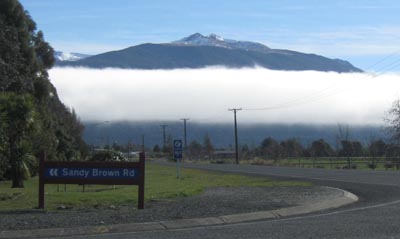
In 2010 Roger Strong took this photograph travelling south in New Zealand. He says:
'We had just spent six nights and seven days on a 100ft Milford Wanderer in the incredible isolation and marvellous scenery of Fiordland.
In Te Anau township with a backdrop of the mountains that surround the town by Lake Te Anau, I saw this sign for Sandy Brown Road and thought that you might like a copy.'
© Sandy Brown Jazz 2008 - 2014