[Some computers might ask you to allow the music to play on this page]
Tubby Hayes and the Arrival of Rock 'N' Roll |
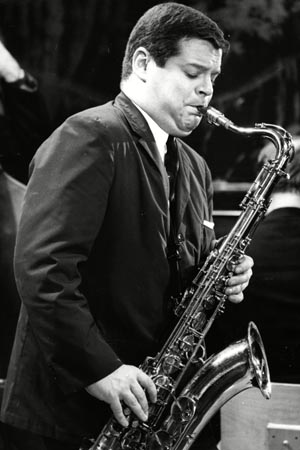
The following extracts are from Simon Spillett's excellent, comprehensive book on saxophonist Tubby Hayes:
Benny Green wrote in the New Musical Express in the mid-1950s:
"In some weird way that defies explanation, Edward Brian 'Tubby' Hayes has, over the past two or three years become something of a legendary character to the teenagers of the provinces. He has somehow captured the imagination of the younger fans possibly because he is no older than they are and they can identify themselves with him and enjoy a sort of vicarious self-pride when he does something special, perhaps because the boisterous happy spirit is there for everyone to see." ...........
'The final months of the Tubby Hayes orchestra's existence were blighted by the same problems that had beset its entire lifespan, but now the lack of suitable work, surfeit of unscrupulous promoters and an ever-decreasing jazz content were squeezing any enthusiasm there was left from its members. Just a short while earlier it had been possible to laugh off these tribulations after all, they were still a relatively new band making their way, with much still to prove. But after a year and a half on the road these topsy-turvy fortunes were beginning to breed a deep cynicism, much the same as that which had spelled the end of the Ronnie Scott band the previous year. Hayes' outifit, however, had to face something Scott's group never had to ......'
'With the entry of Bill Haley and the Comets' recording of 'Shake, Rattle and Roll' into the UK charts in December 1954, rock and roll arrived in Britain ..... Although a personality like Bill Haley was unlikely to upset anyone - not exactly svelte and the wrong side of thirty, he made an unlikely teen hero - the line of performers, both black and white, that followed in his wake was an entirely different proposition .......'
Bill Haley and the Comets with Shake, Rattle and Roll.
'..... Anglicizing the new style was no easy matter but Flamingo club boss Jeff Kruger wasted no time getting in on the act. Suggesting to Tony Crombie a group built on Bill Haley's model, he initially received a rebuff, but, having experienced immense difficulty in keeping his own ambitious bands together, the drummer realized the idea might afford him a possible way out of the small-time finances of the jazz scene. Thinking big, he demanded £100 a week, a figure Kruger thought was astronomical, but which he eventually agreed to. Thus Tony Crombie and The Rockets, Britain's first rock and roll band, were born. Their success was instantaneous. The band's opening night at Portsmouth in September 1956 had sold out within hours of tickets going on sale and soon Crombie and Kruger were raking in money. Within a further three weeks Kruger had bought a Rolls Royce. Both men knew that percentage jazz gigs in far-flung village halls would never have earned this. .........'
Tony Crombie and the Rockets play Brighton Rock.
'.......Hayes was uncertain exactly which direction his career would take next, but he was far from worried. "Tubby sat drinking tea and beaming all over his face," reported Beat magazine's Carl Carter which mixed and matched some of the leading local players in staged jam sessions encountering him at Archer Street's Harmony Inn that autumn. "No-one could detect that this young man had just received a blow that would have made most men of 21 give up. After a couple of years' hard work he had wound up with no band, no money, no nothing - just for trying to give pleasure to the thousands of fans throughout Great Britain. A year and a half of the inconsistent fortunes of commercial bandleading had been quite enough and he relished his new found freedom. That autumn he became part of the touring entourage of Bix Curtis's Jazz From London (JFL), an English equivalent of Jazz At The Philarmonic (JATP) .......'
'......There was no mention of the moral threat of rock and roll (in a statement by Bix Curtis about jazz being on a decent footing for young people) but the implication was clear: modern jazz might suddenly, and ironically, find itself lifted from subversive to saviour, providing an antidote to the new generation of hip-swivelling, surly teenagers ........'
From: The Long Shadow of the Little Giant : The Life, Work and Legacy of Tubby Hayes by Simon Spillett
Bix Curtis was right and by 1965 Tubby Hayes was back with a big band.. Here is a video of him from the BBC Jazz 625 series.
© Sandy Brown Jazz 2021
Visit some of our other Take Two pages:
Mingus Moving On
Count Basie - By The Time We Reached Kansas City
Blind Willie Johnson
Bird At Dial
