
B.B. King and Sam Phillips |
Sam Phillips founded the legendary Sun Records in Memphis in 1952. Two years earlier in 1950 he had opened the Memphis Recording Service where he let amateurs record, and that included performers such as B.B. King, Junior Parker and Howlin' Wolf. Phillips then sold the recordings to larger labels. One of these was Modern Records of Los Angeles, owned by the Bihari brothers who would also set up Meteor Records in Memphis.
Our story is from the time before B.B. King made his first recording with Sam:
'The Bihari brothers came to town toward the end of July, and after all his long-distance communication, when he finally met them in person Sam was duly impressed ..... As promised, they brought in Riley King, the personable twenty-four-year-old DJ, whose popularity on the radio, where he played music with his own combo and spun records, allowed him to find work five or six nights a week in every little cotton-patch joint and roadhose operation within a hundred-mile radius of Memphis. He had started out as the Pep-ti-kon boy on WDIA about a year and a half ago, going out on a flatbed truck to promote its owners' new blood-building tonic. But he had quickly become more broadly 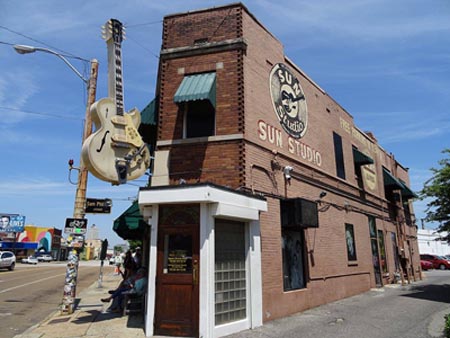 identified by a less product-oriented label, firs as the Singing Black Boy, then as the Singing Blues Boy, then as the Boy From Beale Street, until, finally, he was simply recognised as Bee Bee - transmitted to the world at large on his records as "B. B." - King.
'Sam liked him immediately. Motherless at nine, on his own from the age of fourteen, when his grandmother died, he was the product of a lonely, isolated childhood, mostly around Kilmichael in the hill country of Mississippi, which only served to accentuate a sensitive, insecure nature. Be kind to others, his mother had told him on her deathbed, and his kindness would never fail to be repaid - if he gave love unasked, it would come back to him many times over - and that was the credo which he continued to articulate throughout his life.
'His shyness, his slight stammer, set him apart from many of the other bluesmen Sam had met, but it was his wounded air that drew Sam to him most ..........As a musician, though, he was distinctly limited. It was obvious that his primaray influence was T-Bone Walker's cool, jazz-inflected style, with the elegant shape of his single-string guitar solos set off by sophisticated seventh- and ninth-chord progressions..... but he (Sam) still saw B.B. as retaining some of that old Mississippi feel, and, as it turned out, B.B. couldn't really play in the more modern style anyway. For one thing, he couldn't always execute the pretty chords he was aiming for. For another, his timing, which in T-Bone's case was the rock-solid basis for his blues, was erratic. But most surprising of all, he couldn't sing and play at the same time. Sam thought at first he was kidding, but B.B. assured him he was not - he had tried, and he simply could not. It had to be, Sam assumed, some kind of mental block.
...... B.B. came to the studio with his own little trio, and Sam was more than satisfied with the quality of the musicianship - it was the music itself that betrayed the singer's lack of style of his own. The four numbers that they worked on were an inoffensive boogie, a slow-paced, full-voiced version of an old Leroy Carr standard, a polite Charles Brown-styled blues with a shared piano-guitar lead, and a variation on Tampa Red's recent remake of his slide guitar classic, "It Hurts Me Too." B.B. was unquestionably sincere, he projected a kind of earnestness that was unusual in and of itself, and his vocals were strong enough, Sam realized, to fill in the spaces where the guitar dropped out - but, for all the undeniable gospel feeling in his voice, he was almost too eager to please, unwilling at this point to extend himself into the realm of the unexpected, no matter what gentle cues Sam might give him.
The Bihari brothers seemed delighted in any case ...... Saul (Bihari) was supposed to bring B.B. to the studio the next day so they could all sign an agreement under which B.B. would be contracted to the Bihari's record company but Sam would have a side agreement, a kind of royalty override with some say in the artist's future disposition. But Saul showed up alone at the studio and said he had been out to B.B.'s house the night before and signed him to a standard union contract ...... Sam protested vehemently - as he understood it, they had a firm "shake-hands" deal. But no matter how much he expostulated, Saul simply demurred in his charming way ... and in the end Sam comforted himself with Saul's assurances that this was only the beginning of a long and profitable relationship......'
From the very readable Sam Phillips The Man Who Invented Rock 'N' Roll by Peter Guralnick.
The world knows how B.B. King became one of the most influential blues musicians of all time. If there is any doubt, here is a video of him playing Sweet Little Angel. The date, venue and band members are not given, I would guess it might have been filmed sometime in the 1970s. One YouTube commentator writes "I am in my teen age. Many of my friends are into pop music but for me blues hit different.... I wish you was alive today and I could watch you perform live somewhere."
B.B. King passed through the Departure Lounge in May 2015. In this brief extract from an interview when he was 79 he talks about his early days and Pep-ti-kon tonic: " .... it was 12% alcohol, so I didn't know then why they bought so much - now I do!.....".

Visit some of our other The Story Is Told pages:
Mavis Staples - Crossing Over
Censoring Ellington
Humphrey Lyttelton - Continental Drift
Mingus Moving On