
[Some computers might ask you to allow the music to play on this page]
Oscar Rabinby Jeff Duck |
Oscar Rabin was born in Riga, Latvia’s capital city on April 26th 1899 to a family of Jewish origin. Oscar Rabinowitz moved to England as a young child with his family, changed his name to Oscar Rabin and eventually became an accomplished band leader whose first instrument was the violin. After winning a scholarship in his teens Oscar attended the Guildhall School of Music. He was a shy, reserved person, described as 'short and fat', and not particularly suited to being a 'front man'. In the early 1920s he formed a small dance band called The Romany Five which could often be heard playing at the Palais de Dance in Derby as well as other popular dance halls and clubs.
In time, the band expanded and Oscar moved from playing the violin to playing the bass saxophone. It was singer/actor Harry Davis who fronted the band as compère and conductor.
Listen to The Romany Five with vocalist Elsie Carlisle (recorded as 'Brockman's Band') and Deep Water. The musicians are: Harry Davis (banjo, guitar, director); Hamish Christie (trumpet/trombone); Johnny Swinfen, Raymond Doughty (clarinet, alto sax); Sid Brown (clarinet, tenor sax); Oscar Rabin (bass sax, violin, leader); Alf Kaplan (piano); Cecil Walden (drums).
After a number of personnel changes a change of name was called for and the Romany Five became the Oscar Rabin Band. They were resident at the Hammersmith Palais and the Astoria, Charing Cross Road for most of the 1930s with their first recordings released in 1933. During the early and mid-1930s there were further changes to the band's line-up and it was around this time that actor Sam Kydd started his career as the band's M.C. By the start of the second World War the Oscar Rabin Band had become one of the most popular and best known British dance bands, often away from London on national tours. Oscar’s main job was to run the business side of the band, Harry Davis who occasionally played guitar, was excellent as the front man and great with audience. Oscar was more often thought of as just a player in the band by the public but certainly not by the band members.
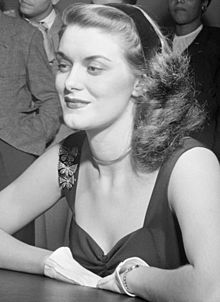
Beryl Davis
We can watch a video of the band playing Rural Rhythm in 1937. Beryl Davis is singing here when she was just 14 / 15 years old. Harry Davis is the guitarist and Oscar Rabin is conducting.
The band had a busy touring schedule during the 1940s plus regular gigs at some of the UK’s top clubs and dance halls. This was followed by a three month residency at Mecca’s Lyceum Ballroom in London’s The Strand in the 1950s, a residency that was extended to last over five years and which consisted of six afternoon and six evening performances a week. Harry Davis’s daughter Beryl was a singer of small fame in the early fifties but would sing with the band occasionally along with other session singers. As time went on Beryl gained more experience, became quite popular with the public and went on to sing with various other bands including Geraldo's, and the Sky Rockets Dance Orchestra. She sang for British and Allied troops during World War II, and when Glenn Miller discovered her in London, she also sang for the Army Air Force Orchestra. She also performed and recorded with Django Reinhardt in Paris.
Llisten to Beryl again, this time singing I Ain't Got Nobody from a compilation album Dancing The War Away. I think the 'Diane' here is Oscar Rabin's wife Diane Rabin, but I have been unable to verify this. [Mike Rabin, Oscar Rabin's grandson, writes: 'Just been reading your piece about the Oscar Rabin Band. Thought I could clear up a query about the vocalist, Diane, possibly being Oscar’s wife. In fact she was the wife of Oscar’s son, Bernard Rabin, who represented the Band as manager, and eventually created the Rabin Agency, which was eventually incorporated into the Mecca entertainment company. I am Mike Rabin (son of Bernard and Diane) and was privileged to know my Grandfather Oscar Rabin, until his untimely death at 58 years of age. I would like to thank you for putting his story out there. Apart from being a very successful Band leader, he was also an extremely kind man, whose wisdom and wit I still recall fondly to this day.']
Harry Davis left Oscar in 1953 leaving England to live in California with his daughter and her husband; Harry was quickly replaced by the band's alto and clarinnettist David Ede.
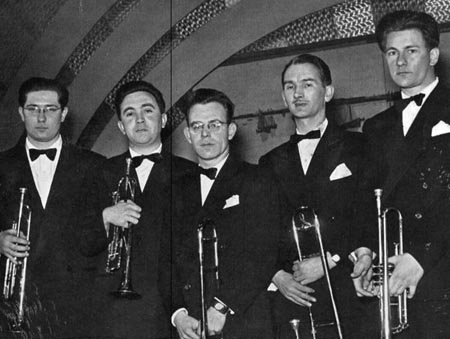
Oscar Rabin's brass section:
Left to Right - Ronnie Heasman, Bobby Banstead, Ken Wray, Jack Waters and Roy Simmonds.
The 1950s were just as busy as the 1930s and 1940s and included the Rabin Band's longest running BBC radio series, the highly successful "Go Man Go", which ran weekly for 4 years. Oscar was not only a talented musician and business man, he was also very apt at noticing and plucking talented players and singers from obscurity, giving many a player and singer their first chance and a push in the right direction. Saxophonist Roy Bull, who played for Oscar for a number of years, is reported as saying: "My memories of the Oscar Rabin days are all very pleasant ones as Oscar himself was one of the most kindest people I have ever met, and certainly the best band leader for whom I ever worked."
Oscar would always have high standards for his players and singers to reach, with players sometimes numbering up to sixteen with sometimes two or three singers. Well-known musicians who played in the band included Ken Mackintosh (alto sax); Ken Wray (trombone); Eric Jupp (piano / arranger); Kenny Clare (drums); Don Rendell (tenor sax); Jimmy Deuchar (trumpet) and Arthur Greenslade (piano / arranger).
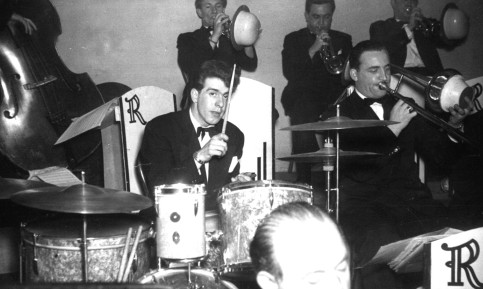
Kenny Clare
It might not be generally known that the late comedian Bernard Manning was at one time with the band as singer and compère.
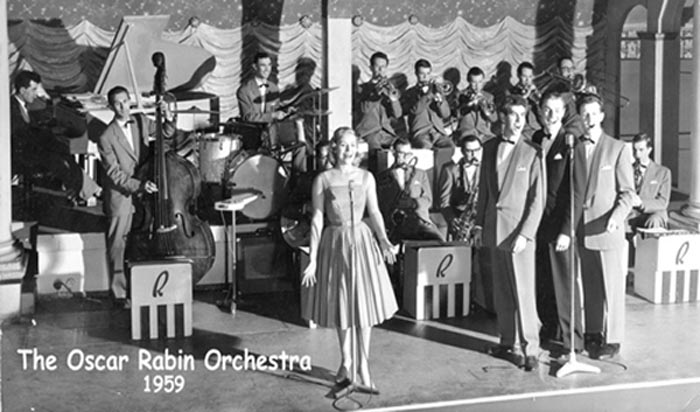
Oscar Rabin died in London in 1958, but his band continued under the leadership of David Ede and the management was taken on by Bernard Rabin (Oscar’s son). They held a residency at Wimbledon Palais from the late 1950s through the early 1960s. After the 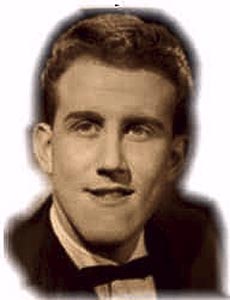 death of David Ede in the mid-sixties, drowned in a sailing accident off Blackpool, the Oscar Rabin band was disbanded; fortunately the name Rabin continued in the music world with the Mike Rabin Band, led by Oscar's grandson.
Ray Pilgrim
Vocalist Roy Pilgrim spoke often of his association with The Oscar Rabin band. “As teenagers in the fifties we would go dancing every week to a big band at various ballrooms ... including The Oscar Rabin band at the Lyceum London and at the Wintergardens Blackpool. Little did I know that one day I’d be singing with them! I sang with them for almost four years from December 1958 to September 1962, in fact the whole time I was at university. It was an incredible feeling for me as a raw new singer to be singing in front of a full orchestra of the finest musicians both in the ballroom and in concerts such as the Royal Albert Hall, and of course some 200 BBC radio broadcasts as well. My contract with them expired at the end of 1961 and they wanted me to extend it, but I couldn’t because I knew I was due to graduate in the Summer of 1962 and would be starting a new career outside of music. For the last nine months our agreement was based on nothing more than handshakes”.
A very fitting comment to the way The Oscar Rabin band worked even after his death.
Listen to the Oscar Rabin Band playing At The Woodchoppers' Ball from a compilation album The Big Band Dance Hits 1930 - 1940.
More information about the Oscar Rabin Band is held by the National Jazz Archive (click here).
Jeff Duck runs CJRO Records in support of charities - click here for more information.
Dave Self picks up on our page about bandleader Oscar Rabinand writes: 'Firstly when I was 18 years of age I used to go to the Lyceum in London and see the Oscar Rabin Band and often wondered what happened to Marion Williams as she was a really good singer, but disappeared off the scene, and of course Mel Gaynor whose only one record for Decca was "Idle Gossip" . I also knew of the tragedy of David Ede drowning, (Oscar's Musical Director), and Johnny Worth who used to also perform in Oscar's band and of course, finally Johnny Greenslade, a fine piano player also with Oscar. (Dave Self jazz aficianado and now 82 years of age having been a broadcaster and follower of Jazz since the 1950's)'
2020.8
Brian in Hong Kong is in the process of setting up an audio channel on YouTube under the pseudonym of Honest 'Arry's Go Man Go Channel featuring the music of Oscar Rabin, Marion Williams and David Ede. There is already a good selection of well recorded music. Brian says: 'Marion is a superb artist. I’ve listened to this episode probably more than a hundred times over the last half century and never cease to be astounded by her artistic mastery. It’s sad that she didn’t become more prominent and I’d love more people to hear her.' Click here to explore Brian's channel.
2020.9
Adrian Howlett sends this poster saying: 'You may be interested in attached for your page on Oscar Rabin. It was posted on Old 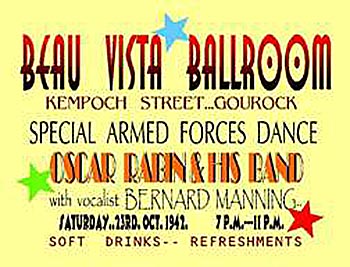 Gourock Facebook page. Gourock overlooks the Clyde estuary which was where the Navy boats anchored and hundreds of thousands of troops landed during the war. Interestingly the Queen Mary disembarked 20,000 American troops (who embarked in New York) in Gourock 20 days before this concert. I wonder if any attended?
Sadly the day before she arrived in Gourock the Queen Mary collided with HMS Curacao at 2:12 pm. The massive Queen Mary split Curacoa in two, leaving the cruiser’s halves engulfed in flames. She sank six minutes later with a loss of 338 men – from a total crew of 439. The Queen Mary was under strict orders not to stop for anything and continued on to Gourock, where she was outfitted with a concrete plug and sailed to Boston for more permanent repairs 5 days later. These guys lived through tough times.
Gourock was more a “seaside” town for entertainment with the Cragburn Pavilion. Many local bands played regularly for dancers from 1936 to 1966 including Charlie Harkin's Kit Kat Orchestra and Henri Morrison and his Swingstars. Both bands were contenders in the All British Dance Band Championships. As Cragburn became established, many of Britain's top bands visited, including Joe Loss, Oscar Robin, Lew Stone, and many more. Cragburn also hosted a summer show each year with top artists from Scotland including Tommy Morgan, Alec Finlay, Larry Marshall, and The One O-Clock Gang.
2021.3
© Sandy Brown Jazz
You might also like these pages:
Click HERE to join our mailing list