[Some computers might ask you to allow the music to play on this page]
Jazz and Spirituality by Howard Lawes
|
In these gloomy days of lockdown the contribution that music in general and jazz in particular makes to brighten our day and provide an uplifting experience is no doubt familiar to us all, in some cases a really spine-tingling musical experience may be described as 'spiritual' but how does this description fit in with our view of ourselves or the world at large?
My first saxophone tutor, who I always called Mr. Baxter, was a lovely old gentleman who had spent much of his life playing in dance bands, he introduced me to the joy of music-making and when he sadly died I was pleased that I was able to go to his funeral to pay my respects. During the service an amazing pianist whose name I cannot remember played a jazz version of Hoagy Carmichael's tune Stardust which produced a feeling in me that many would call intensely spiritual. The combination of my affection for Mr. Baxter, the sadness of the occasion and the beauty of the music just overwhelmed me and I have never forgotten the experience. The power that music has to generate such emotion is a wonderful thing and is of course not restricted to jazz, but surely jazz, with the history that it has, should be just as spiritual as any other art created by humans.
The word 'spirit' and by extension the words spiritual and spirituality have a host of meanings. In the context of the arts we think of the human spirit, the soul and the sacred and while many connect spirituality with religion it seems that those without any religious belief can also achieve a feeling of spirituality through meditation for example and of course music. To further discuss this  subject I chatted with jazz drummer and priest Spike Wells. Spike first encountered spirituality when he became a boy chorister at Canterbury Cathedral in the 1950s. He went on to graduate from Oxford University and was about to embark on further academic study when he successfully auditioned to become the drummer in the Tubby Hayes Quartet which, in the late 1960s, was one of the top jazz units in the UK. It was also around this time that Spike played with clarinettist Sandy Brown and he recalls that in 1969 they both went to Hungary to play in a jazz festival. Tragically Tubby Hayes died at the age of 38 and Spike gave up full time drumming to become a solicitor. However, Spike's love of jazz remained and in a way deputised for religion - as he explains, "Jazz has fed my soul throughout my life. I can’t begin to describe the joy and fulfilment it has brought me". In the 1990s Spike felt called to change career again and in 1996 he became a full-time priest; but jazz continued to be a large part of his life as he played with the likes of Bobby Wellins, Alan Barnes and Gwilym Simcock and just this year has released an album with Riley Stone-Lonergan and Eddie Myer called QOW Trio.
For Spike, jazz is an essential part of his life, "If I can't hear any good jazz for more than a few days I get withdrawal symptoms" and "Playing in a group with collective improvisation demands love and generosity: it’s one of the most profound spiritual experiences of my life, making music together". In this he agrees with the composer, John Rutter, who said "To express it simply, it is a meeting place where believers and non-believers can share something unique and spiritual - and agree". The poet, jazz critic and non-believer Philip Larkin was a great fan of the jazz clarinettist Sidney Bechet and in his poem For Sidney Bechet he writes "On me your voice falls as they say love should," surely describing an experience that for others would be spiritual, but for Larkin was something else.
Jazz evolved in large part out of the music and culture of Africans who were transported away from their homelands to become slaves. Given their enslavement and also the suppression of their own religious beliefs in favour of Old Testament stories such as the Exodus of the Israelites from Egypt and subsequent delivery from slavery by God, it is perhaps not surprising that such stories resonated with slaves striving for freedom and civil rights. Stories were converted into songs that were often in a call and response format and came to be known as 'Spirituals', many were slow and sad, known also as sorrow songs but others were happier and included rhythms and syncopation that would resurface in jazz. Jazz musicians such Louis Armstrong have recorded versions of these Spirituals and "Sometimes I Feel Like a Motherless Child" is an example. The traditional New Orleans style funeral incorporates Spirituals, beginning with a slow tempo song or instrumental piece (dirge) expressing sorrow and mourning followed by celebratory music once the formal ceremony is over. Anyone who was a member of the Scouts or Guides in their youth will remember singing the Spiritual Kumbaya around a campfire.
Listen to Louis Armstrong with Sometimes I Feel Like A Motherless Child.
Another form of music originally popularised by African Americans (and other communities such as the Afro-Carribean community in the UK) is Gospel music. This music has a number of styles and links with Blues and Spirituals but probably the best known and most popular is the exuberant choral singing responding to calls from a leader and accompanied with swaying or dancing, clapping and foot-stomping. Popular early exponents of Gospel singing include Sister RosettaTharpe (e.g. Down by the Riverside) and Mahalia Jackson (e.g. Move On Up A Little Higher) but Gospel singing, particularly in the choral format, has enjoyed great success in modern times with BBC televised competitions (Gospel choirs seem to be particularly popular in universities) and at the wedding of Prince Harry and Meghan Markle where the Kingdom Choir made a huge impact.
The Kingdon Choir singing Stand By Me at the royal wedding.
While Gospel music is separate from Jazz, Duke Ellington employed it in his ground-breaking composition Black, Brown and Biege, which was performed at Carnegie Hall, New York in 1943. Despite Ellington's admirable intention to present an African-American history in music and narrative the piece had mixed reviews, fitting neither into the jazz nor classical music idiom although a later, recorded version featuring Mahalia Jackson improved its reception.
While Duke Ellington's music has always contained spiritual elements, his Sacred Concerts that were performed between 1965 and 1973 were religious extravaganzas involving more than 150 singers, dancers and musicians.
Here is a video of Duke Ellington and the 1965 premier performance of his Sacred Concert.
Philip Larkin, who was not over enamoured with church going dismissed them "as just the sort of pretentiousness to fill a modern cathedral" although Ellington described them as "the most important thing I have ever done". In 1990 Ellington's Sacred Concerts were perfomed in Durham Cathedral as part of the 900th anniversary celebrations and re-arranged into a mass by Stan Tracey.
The performance was repeated in 2006 in St Paul's Cathedral in London and received an enthusiastic review from The Guardian's John Fordham. In 2019 the Royal Albert Hall in London was filled during the BBC Prom Season when Peter Edwards conducting the Nu Civilisation Orchestra, Monty Alexander on piano, vocals by Carleen Anderson and tap dancer Annette Walker once again recreated some of Ellington's Sacred Concerts.
A contemporary of Ellington who also played in his early band, The Washingtonians, was Mary Elfrieda Scruggs, better known as Mary Lou Willams. An extremely talented pianist, bandleader, composer and arranger, Williams worked herself to a standstill in her 40s and in reaction to the death of her friend, Charlie Parker, decided to opt out of music. She was persuaded to resume a musical career following her conversion to Catholicism and subsequently composed a series of jazz masses.
One of the masses, Music for Peace, was choreographed by Alvin Ailey and performed by the Alvin Ailey Dance Theater as Mary Lou's Mass in 1971. "Americans don't realize how important jazz is," she told the New York Post in 1975. "It's healing for the soul. It should be played everywhere — in churches, nightclubs, everywhere. We have to use every place we can."
A brief video with extracts from Mary Lou's Mass.
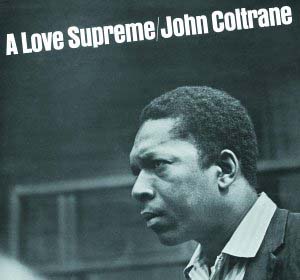
John Coltrane also had a profound religious conviction, heightened as he recovered from drug addiction, and he composed a piece called Spiritual that features on his Live At The Village Vanguard album released in 1962. As well as Coltrane the piece had Eric Dolphy on bass clarinet, McCoy Tyner on piano, Reggie Workman on double bass and Elvin Jones on drums. This is the same band (without Dolphy) that performed on Coltrane's most famous recording, A Love Supreme, released in 1965 and if ever there was any doubt that spirituality exists in jazz this suite dispelled it. On the album liner notes Coltrane talks of experiencing a spiritual awakening in 1957 and asking God for "the means and privilege to make others happy through music" and he was in no doubt that his prayer had been answered. A Love Supreme was the culmination of Coltrane's modal jazz period that had included Kind Of Blue with Miles Davis and Coltrane's My Favourite Things before he went on to embrace a more avant-garde style. A Love Supreme is seen as a prime example of spiritual jazz, a style that was also explored by the likes of Pharoh Sanders, Yusef Lateef, Sun Ra and Albert Ayler. Musicians playing spiritual jazz espoused a variety of religions and also a celebration of Africa as the spiritual homeland of African Americans.
Listen to John Coltrane with Spiritual.
A Love Supreme was the inspiration for a four part suite of music composed by Jazz Warrior Rowland Sutherland and first performed in London's Union Chapel for the 2014 Meltdown Festival. The piece called Enlightenment was performed by a multi-national ensemble with a range of spiritual beliefs and practices and for the audience "the mission was to follow in the footsteps of those musicians who have opened the pathways and, like John and Alice Coltrane, send out a healing message of Elegance, Elation, Exaltation and Supreme Love into a turbulent and deeply troubled world".
A Love Supreme is also reflected in recordings by guitarists John McLaughlin and Carlos Santana. John McLaughlin's Mahavishnu Orchestra is named after an Indian spiritual leader, Sri Chinmoy, of whom McLaughlin was a follower; their first album was called The Inner Mounting Flame. McLaughlin introduced Carlos Santana to Sri Chinmoy and Santana became a committed disciple. They produced a joint album called Love, Devotion, Surrender, much influenced by John Coltrane, the first track being called A Love Supreme and the second Naima.
A video of John McLaughlin and Carlos Santana playing The Life Divine at Montreaux in 2011.
Spiritual jazz is all very well but if you are not a jazz fan you may let it pass you by. However, in 1993 the inspired pairing of the Hilliard Ensemble, a British vocal group specialising in medieval sacred music and Jan Garbarek, Norwegian jazz saxophonist, resulted in the highest selling album ever for the ECM record label and which probably outsold all but a dozen or so of the top selling modern jazz albums by the likes of Miles Davis, Herbie Hancock and Dave Brubeck. The title, Officium, is derived from Officium Defunctorum (Office of the Dead), a medieval requiem mass put to music by the Spanish composer Christobal Morales (c1500-1553) and heard performed in Seville Cathedral by ECM head, Manfred Eicher. Following the success of Officium a sequel, Officium Novum was recorded and released in 2010. The albums were recorded in an ancient monastery where the acoustics suit the style of music but it seems that some were unhappy that jazz music should be performed in a church as the BBC in its review said "While some listeners may potentially feel alienated by the use of such Christian locations and by the religious connotations of some of the repertoire, they should not let this spoil their enjoyment. Sung in various languages, the music carries no overtly religious messages and is not attempting to preach to anyone. Instead, those of any faith or of no faith can appreciate its simple beauty".
A video of Jan Garbarek and the Hilliard Ensemble with Pulcherimma Rosa.
The most popular sacred music played at funerals in the UK is the Benedictus from The Armed Man, subtitled A Mass for Peace. Its composer, Karl Jenkins, was a one-time jazz musician and member of the band, Soft Machine and has performed at Ronnie Scott's jazz club. In an interview with the Church Times in 2008 Karl Jenkins expressed the view that neither spirituality nor music should be compartmentalized, in other words, spirituality may be experienced irrespective of religion through whatever form of music works for the listener. This view seems to be entirely in agreement with those of Spike Wells and John Rutter mentioned earlier.
Another example is the spiritual influence in the music of Herman Blount who changed his name to Sun Ra (after Ra, the Egyptian god of the sun). Whether or not one accepts his claim to be an alien from Saturn on a mission to preach peace, he was a prolific composer with inspirations ranging from outer space to the part that music played in the spiritual and cultural life of communities in Africa, considered the spiritual home of jazz. An album that seems to combine both the spiritual and African roots is called Cosmic Tones for Mental Therapy, try the track Moon Dance.
Of course, there are many other examples of spiritually inspired jazz - Jazzman Records has a series of albums called 'Spiritual Jazz' that you might like to explore - album 7 focusses on Islamic Jazz - try Morning by Yusef Lateef:
However, perhaps you can't get away from the fact that when it comes to spiritual experience then it's generally sacred music or a good mass with a large choir (missa cantata) that hits the target for many people, and following in the footsteps of Mary Lou Williams a number of composers have come up with jazz masses. A really popular one with choirs, perhaps because it is a shortened mass (missa brevis), is Bob Chilcott's A Little Jazz Mass (2008) while other examples with choir include Rod Paton's Ascension Jazz Mass (completed in 1990) and Will Todd's Mass in Blue (2003). Examples with smaller ensembles include James Tatum's Contemporary Jazz Mass (1974) and Hermeto Pascoal's The Slaves Mass (1977). The Anglican Church version of a missa cantata is called a sung eucharist and in 1990 Stan Tracey was commisioned to convert some of Ellington's Sacred Concerts into a sung eucharist as part of the commemoration for the 900th Anniversary of Durham Cathedral. Stan Tracey's version was performed again in 2006 at St Paul's 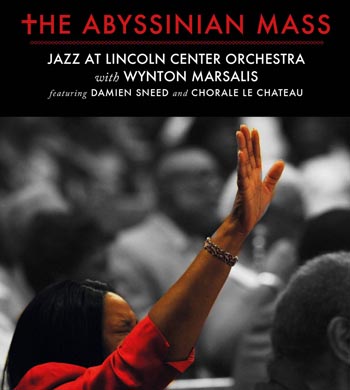 Cathedral in London and was praised by Guardian jazz critic John Fordham. Tim Watson witnessed the performance in Durham Cathedral and found the experience inspirational. In due course, having himself become an Anglican priest, he arranged a sung eucharist himself but in this case used the iconic jazz of Miles Davis as the music, and then called it A Kind Of Bleucharist !!!! Actually Miles Davis has said A Kind Of Blue was inspired by the gospel music he used to hear walking home from church so one imagines he would be cool with Tim Watson's arrangement if not the title. A recent addition to the jazz mass catalogue is Wynton Marsalis's Abyssinian Jazz Mass (2016) which took five years from commission to performance. This mammoth piece (approx 2½ hours) celebrates the 200th anniversary of Harlem's Abyssinian Baptist Church with the whole, magnificent performance in New York - click here.
Despite its early links with Spirituals and Gospel music, jazz was for a long time considered far more secular than sacred, jazz in the Jazz Age epitomised outrageous behaviour and conspicuous excess, later it retreated to rather less glitzy and for some intimidating establishments. It is in more recent times that not only has music of all types been welcomed into places of worship but also that ecumenicalism has engendered a feeling of tolerance and friendship between those of different faiths as well as those with no faith. Spike Wells said in one of his sermons "Well, it is true that you don’t have to believe in a god before you can paint, write or play beautifully or before you can be moved to tears by what you look at, or read, or hear. But even the most sceptical doubters must acknowledge at least the possibility, however slight it may seem to them, that God’s grace is silently and invisibly at work behind the scenes producing the talent, its fruit and the appreciation of it."
For jazz drummer Spike Wells making music together is one of the most profound spiritual experiences of his life. During the Covid-19 lockdown making music together has been something that many of us have missed greatly but whatever it is that drives us has been harnessed by the London Vocal Project under the direction of Pete Churchill to produce something beautiful. It seems to me that jazz can take you on a beautiful journey which for some becomes a truly spiritual experience while for others the journey is just as beautiful but more of a mystery tour.
A video of the London Jazz Vocal Project with O Come, O Come, Emmanuel / Freedom's On The Way.
Other pages you might find of interest :
© Sandy Brown Jazz 2021
Click HERE to join our mailing list